Too Specific to Translate: How Gen Z Is Inventing New Words for Who They Are
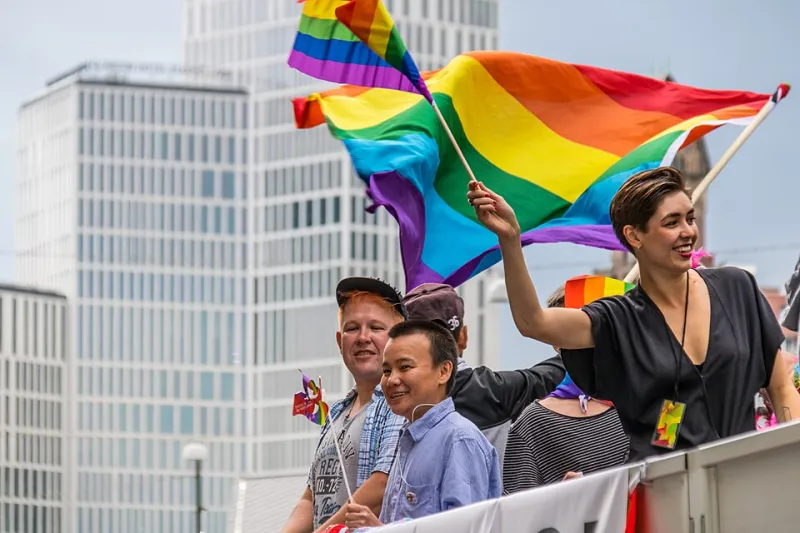
Photo: Susanne Nilsson, CC BY-SA 2.0, via Wikimedia Commons
There's a word for the feeling of being romantically attracted to someone only after building a deep emotional bond, but not experiencing that attraction in a sexual way, but also only under very specific emotional conditions that are hard to articulate to anyone who hasn't felt them. That word exists. It lives in a Google Doc shared across a private Discord server. It has a flag. It has a wiki entry. And if you've never heard of it, that's kind of the whole point.
Welcome to the frontier of identity language — a sprawling, self-organized, deeply online ecosystem where Gen Z is doing something genuinely new: building entire vocabularies for experiences that previously had no name at all.
Labels Are Old. Microlabels Are the Future.
For most of modern history, identity language moved slowly. Categories like "gay" or "bisexual" took decades to gain mainstream traction. The LGBTQ+ umbrella expanded gradually, each addition a hard-won cultural negotiation. But the internet, particularly the post-Tumblr, Discord-era internet, broke that timeline completely.
Now, new identity terms can go from coined concept to community-adopted label in a matter of weeks. Microlabels — hyper-specific descriptors that go far beyond broad categories like gender or sexuality — are proliferating at a pace that genuinely defies documentation. We're talking about terms that describe not just who you're attracted to, but how, when, under what emotional conditions, and with what specific nuance.
Think of it less like a dictionary and more like a living, branching taxonomy. The broader categories still exist — but beneath them, younger communities are adding sub-branches, sub-sub-branches, and sometimes entire new trunks that didn't exist in the original tree.
The Neopronoun Situation
If microlabels are the nouns of this new identity language, neopronouns are the grammar. Beyond "they/them" — which has now entered mainstream usage to the point of appearing in AP Style guides — there's an entire universe of pronouns being actively used in online spaces.
Some are noun-based: xe/xem, fae/faer, it/its reclaimed as an affirmative choice. Others get weirder and more specific — pronouns that connect to aesthetics, fandoms, or personal mythology. Someone might use "star/starself" not as a joke, but as a genuine expression of how they experience their own identity, tethered to a specific set of meanings that feel more accurate than anything a standard pronoun offers.
The mainstream reaction to this is usually somewhere between bafflement and mockery. But that reaction misses something important: these linguistic choices aren't random. They're attempts to solve a real problem — the gap between inner experience and available language.
Language has always evolved to fill gaps. "Schadenfreude" exists because German speakers needed a word for something English didn't capture. Neopronouns are doing the same work, just faster and in public.
Flags, Wikis, and the Infrastructure of Micro-Identity
Here's where it gets genuinely fascinating from a cultural standpoint: these communities aren't just coining terms. They're building infrastructure.
Custom pride flags for individual microlabels are created with striking regularity — each color combination carrying specific meaning, documented in wikis that read like earnest academic papers. The LGBTQ+ Wiki, the Gender Wiki, the Sexuality Wiki — these aren't fringe corners of the internet. They have thousands of active editors and millions of page views.
Private Discord servers function as the laboratories where new terms are workshopped, debated, and refined before they spread outward. There's a whole informal peer-review process happening here, one that most people outside these communities never see. Terms get proposed, challenged, revised. Some stick. Most don't. The ones that survive usually do so because they filled a gap that a significant number of people recognized in themselves.
It's a weird, decentralized, community-driven linguistic project. And it's happening constantly, right now, in servers you're not in.
Why Mainstream Culture Keeps Getting Left Behind
Every few months, a new wave of discourse erupts on platforms like X or Reddit — usually framed as outrage about some new "ridiculous" identity term someone discovered. The takes are predictable. The mockery is loud. And then, quietly, the communities that actually use these terms keep doing their thing, largely unbothered.
The disconnect here is real. Mainstream culture tends to encounter microlabels and neopronouns as isolated artifacts, stripped of context — a weird word, a colorful flag, a pronoun that sounds like a fantasy novel character. Without the community context, without understanding the specific experience the term is trying to describe, it reads as absurd.
But inside these communities, the experience is completely different. There's relief, recognition, a sense of finally having language for something that previously felt unnameable. That emotional reality doesn't make every coined term linguistically perfect or culturally durable. But it does mean the phenomenon is worth taking seriously rather than dismissing.
And here's the thing mainstream discourse consistently gets wrong: these communities aren't demanding that everyone adopt their vocabulary. Most of this language is explicitly internal — built for the people who need it, not for universal consumption.
The Broader Cultural Pattern
Zoom out a little and this starts looking like part of a much larger trend. The same generation that's building micro-identity frameworks is also the one creating niche aesthetic communities with hyper-specific names (cottagecore, goblincore, dark academia), running private Discord servers for interests too granular to have mainstream subreddits, and generally rejecting the pressure to fit into broad, legible categories.
There's a through-line here: specificity as a value. Where previous generations were often pushed toward assimilation — find the broadest category that fits and claim it — younger online communities seem to be moving in the opposite direction. The more precisely a label describes your actual experience, the better. Broad categories feel like approximations. Microlabels feel like accuracy.
Whether or not every term in this ecosystem survives long-term is almost beside the point. Language has always been experimental. Most neologisms die. The ones that stick do so because they name something real. The fact that this generation is running so many experiments simultaneously isn't chaos — it's a pretty efficient way to figure out which words actually work.
What Comes Next
The honest answer is: nobody outside these communities knows. The terms being workshopped in Discord servers today might look completely different by the time they reach wider visibility — if they ever do. Some will fade. Some will get absorbed into broader categories. A few might eventually make it into actual dictionaries.
What seems clear is that the impulse driving all of this isn't going anywhere. As long as people feel that existing language doesn't fully capture their experience, they're going to keep inventing new words. The internet just makes it faster, more collaborative, and more visible than it's ever been before.
Mainstream culture will keep playing catch-up. The communities doing the actual work will keep moving forward. And somewhere in a private server right now, someone is proposing a new term for something that, until this moment, had no name — and a handful of people reading it are thinking yes, that's exactly it.
That's the weird, specific, quietly radical thing happening here. And it's worth paying attention to.